
Tiger-Vac EXP1-40L (4W) RE HEPA (FR-P) W&D
Single-phase TEFC ATEX combined vacuum for shooting ranges and pyrotechnic industries in wet/dry build -- 38 L tank with 38 L liquid capacity, FR-P series for flammable/toxic powders
- Shooting ranges with floor cleaning and gunpowder dust recovery as separate tasks
- Pyrotechnic production where wet quenching is part of the process
- Ammunition and primer production with wet cleaning of stations
- Defence and military where both water-based detergent and dust are handled
- Fireworks factories requiring DT/LC functionality in the FR-P class
- ATEX Directive 2014/34/EU -- II 2GD Ex d IIA T3 Gb / Ex t IIIC T200°C Db IP6X -- LCIE 03 ATEX 6297 -- EN 17348
- EN 17348:2022 (harmonized March 2023)
- IEC 60335-2-69 (industrial vacuums)
Tiger-Vac EXP1-40L (4W) RE HEPA (FR-P) W&D
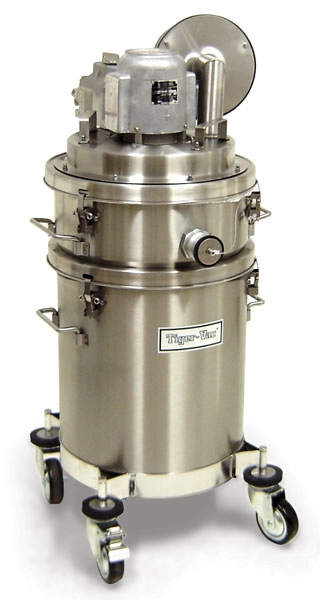
The Tiger-Vac EXP1-40L (4W) RE HEPA (FR-P) W&D is the wet/dry variant of the FR-P series -- same ATEX II 2GD certification to EN 17348 (category 2 for both gas and dust, Zone 1 and Zone 21), same 38 litre collection, same motor and flow -- but with an additional 38 litre liquid capacity via a built-in floater and dedicated liquid filter assembly (211010). This makes it usable where the shooting range or production involves water-based cleaning on top of dry recovery: cleaning concrete floors with water-based agent kept separate from gunpowder dust recovery (dust and liquid must never be collected as a mixture), wet rinsing of primer seats, cleaning after wetted pyrotechnic components. Static-dissipative poly liner and SD accessories are standard. The housing is slightly longer and narrower than the DRY variant (104 x 53 x 61 cm vs 104 x 74 x 48 cm), reflecting the floater and liquid filter components.
Applications
- Shooting ranges with floor cleaning and gunpowder dust recovery as separate tasks
- Pyrotechnic production where wet quenching is part of the process
- Ammunition and primer production with wet cleaning of stations
- Defence and military where both water-based detergent and dust are handled
- Fireworks factories requiring DT/LC functionality in the FR-P class
Technical specifications
| ATEX marking | II 2GD Ex d IIA T3 Gb / Ex t IIIC T200°C Db IP6X -- LCIE 03 ATEX 6297 -- EN 17348 |
|---|---|
| Internal / external zone | -- / 21 |
| Motor type | Single-phase TEFC motor, explosion-proof (Ex d IIA T3 Gb / Ex t IIIC T200°C Db), 1.0 kW / 4.5 A |
| Duty cycle | Intermittent use (a few minutes, a few times a day) |
| Airflow | 224 m³/h |
| Vacuum | 152 mbar (1550 mmH₂O) |
| Container | 38 L |
| Sound pressure | 78 dB(A) |
| Filter class | H class |
| Filter type | HEPA H14 (EN 1822-5, 99,995 % @ 0,3 µm MPPS), 211027B |
| Primary filter | Main filter assembly SD (211013) + liquid filter assembly SD (211010) + pre-filter SD (212007). Change the primary filter when switching between dry and wet. |
| Cleaning system | Ingen (manuel) -- filter skiftes eller bankes rent |
| Collection system | Detachable container |
| Material | AISI 304 stainless steel |
| IP class | IP6X |
| Power | 1.0 kW |
| Current | 4.5 A |
| Voltage | 230 V / 50 Hz / 1~ |
| Inlet | Ø 50 mm |
| Dimensions (L × W × H) | 610 x 530 x 1040 mm |
| Weight | 38 kg |
Questions and answers
How do you switch between dry and wet?
For dry recovery the main filter assembly (211013) is used -- an SD epitropic polyester cloth filter that retains fine dust before the HEPA stage. When switching to wet recovery, the operator removes the dry filter and installs the liquid filter assembly (211010) -- a polypropylene 300 micron filter with a float. The floater system automatically shuts off suction when the liquid reaches max (38 L), so liquid never reaches the filter chamber or HEPA. The procedure takes under 5 minutes. Read the instructions carefully as cross-contamination of filters can damage the HEPA.
Why does it say EN 17348 DT instead of DT/LC?
The Tiger-Vac factsheet for the FR-P series specifies only EN 17348 DT. The Tiger-Vac manual for the RE series, however, names the EXP1-40L (4W) RE HEPA (FR-P) W&D specifically and states EN 17348 DT/LC, i.e. collection of combustible dust or flammable liquids. According to the manual the machine may collect both flammable and non-flammable liquids, e.g. water, acetone and alcohols. For flammable liquids the KANAFLEX hose must be used, and it is not compatible with gasoline, benzene or toluene. Corrosive liquids must not be collected. The machine is for dust or liquid, never a mixture, and the tank, filter and hose must be cleaned and completely dry before switching to a different liquid.
Can I pick up ionic water-based cleaning agents?
Non-ionic and non-flammable water-based cleaning agents in proportional dilution (typically 1:100 to 1:500) are generally OK. Never use strong acids or bases; corrosive liquids must not be collected. Note that AISI 304 stainless is good against most agent types, but chloride-containing detergents can cause pitting on long-term exposure. When in doubt: contact us with the agent's safety data sheet.
How different are DRY and W&D in practice?
Configuration: DRY is 48 cm long and 74 cm wide, 34.5 kg; W&D is 61 cm long and 53 cm wide, 38 kg. They share the same height (104 cm) and same motor. W&D weighs 3.5 kg more and has a slightly different silhouette due to the floater installation and liquid filter chamber. Both can handle all uses that are OK on DRY, but only W&D can officially handle liquids. Price-wise, W&D is typically 15-20 % more expensive than DRY.
How does the floater system work in ATEX?
The floater system is purely mechanical -- a float in the tank that rises and closes the suction inlet when the liquid reaches maximum. No electrics or sensors are involved, which is critical for ATEX: no possibility of spark from signal wiring. The system operates passively and requires no maintenance beyond periodic cleaning of the float. For cleaning: remove the float, rinse and replace -- always ground the unit during the work.
Can DRY and W&D filters be interchanged?
No -- it is important to use the correct filter for each application. Main filter 211013 is a cloth filter for dry recovery; it absorbs water and clumps if used wet, which permanently damages it. Liquid filter 211010 is polypropylene and seals liquid from the HEPA stage; it does not retain fine dust and will let dust reach the HEPA, which will then clog. Always follow the switching procedure.